Buying a Used Car With Cash vs Financing
Buying a Used Car With Cash vs Financing
Buying a used vehicle is one of the biggest financial decisions many people make, and buying a used car with cash vs financing is often one of the first choices you'll need to make. Whether you're shopping for your first vehicle, replacing an older model, or looking for reliable transportation on a budget, the payment method you choose can affect your monthly expenses, available savings, and long-term financial goals.
Neither option is automatically the right fit for every buyer. Paying cash allows you to own the vehicle outright while avoiding monthly loan payments and interest charges. Financing, however, lets you preserve your savings by spreading the purchase cost over manageable monthly payments. The best choice depends on your income, emergency fund, credit profile, and overall financial priorities.
At Gateway Auto Sales in Omaha , we help customers compare their options with confidence. By understanding the benefits and trade-offs of each payment method, you can choose the approach that best fits your budget, lifestyle, and future financial plans while driving home in a dependable used vehicle.
Comparing Buying a Used Car With Cash vs Financing
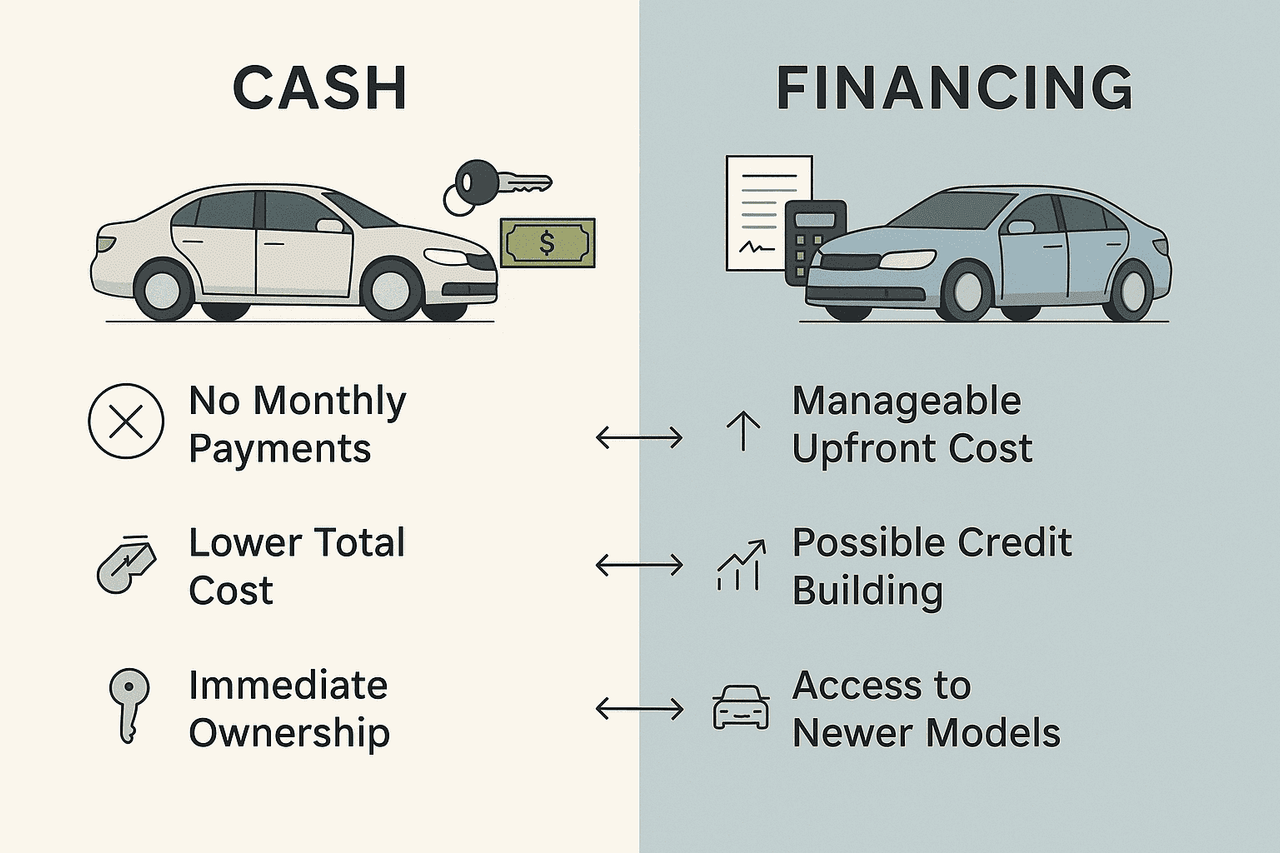
Before deciding how to pay, it helps to compare both options side by side. While both methods can help you drive home in a dependable used vehicle, they affect your finances differently.
| Payment Method | Upfront Cost | Long-Term Cost | Financial Flexibility | Best For |
|---|---|---|---|---|
| Paying Cash | High because the full purchase price is paid immediately | Lower since there are no interest charges | Lower because savings are reduced | Buyers with strong savings who want no debt |
| Financing | Lower with a down payment | Higher due to loan interest and fees | Higher because savings remain available | Buyers who prefer manageable monthly payments |
This comparison provides a general overview. Individual loan terms, interest rates, and financial circumstances will vary.
For many buyers, the decision comes down to balancing immediate affordability with long-term financial health. Someone with a healthy emergency fund may appreciate owning the vehicle outright, while another buyer may value keeping cash available for unexpected expenses.
Gateway Auto Sales works with customers from many financial backgrounds and understands that every situation is different. Rather than focusing on one payment method, it's important to understand how each option fits your overall budget.
Understanding What Paying Cash Really Means
Paying cash means purchasing the vehicle without borrowing money through a lender or dealership. The entire purchase price is paid at closing, usually with a certified check, cashier's check, electronic transfer, or other verified payment method. Once the transaction is complete, the vehicle belongs to you without any loan obligation.
Many buyers choose this route because they appreciate its simplicity. There is no loan approval process, no monthly payment, and no interest charges added to the purchase price. Once you complete the transaction, your ownership is clear from day one.
Some of the biggest advantages of paying cash include:
- No monthly loan payment to budget for.
- No interest payments that increase the total purchase cost.
- Immediate ownership of the vehicle.
- Greater financial peace of mind for buyers who prefer avoiding debt.
- A simpler buying process without lender requirements.
Another benefit is knowing exactly what the vehicle costs. Since there is no financing involved, you avoid additional borrowing expenses that can accumulate over several years.
Paying cash may also provide additional confidence during negotiations. While today's dealerships often receive payment regardless of whether a customer finances or pays upfront, having funds readily available can simplify the transaction and allow buyers to complete the purchase quickly.
However, paying cash also requires careful planning.
Using a large portion of your savings for one purchase can reduce your financial flexibility. If an unexpected medical expense, home repair, or job change occurs shortly afterwards, rebuilding those savings may take time.
Before paying the full amount, ask yourself several questions:
- Will I still have an emergency fund after purchasing the vehicle?
- Am I comfortable reducing my available savings?
- Could those funds serve another important financial purpose?
- Will I still be able to cover insurance, registration, maintenance, and future repairs?
Remember that the purchase price is only one part of vehicle ownership. Fuel, insurance, maintenance, tires, registration fees, and routine service should all be included in your budget.
For buyers with substantial savings and stable finances, paying cash can provide lasting peace of mind. For others, preserving available cash may be the smarter financial decision.
Pros and Cons of Financing a Used Car
Financing allows you to purchase a vehicle by borrowing money and repaying it over time through scheduled monthly payments. Instead of paying the entire purchase price immediately, you typically make a down payment while the remaining balance is financed through a loan.
For many buyers, financing creates opportunities that paying cash cannot.
Rather than using a large portion of your savings in one transaction, financing allows you to keep money available for emergencies, household expenses, education costs, or future investments. This added flexibility can make budgeting much easier, especially for growing families and young professionals.
Some advantages of financing include:
- Lower upfront costs.
- Predictable monthly payments.
- Ability to preserve emergency savings.
- Opportunity to purchase a newer or higher-quality vehicle within your budget.
- Potential to build positive credit history through consistent on-time payments.
Financing can also help buyers who prefer maintaining financial liquidity. Even if you have enough money to purchase a vehicle outright, using financing may allow you to keep your savings invested or available for other priorities.
The overall cost of financing, however, depends heavily on your interest rate.
Buyers with strong credit often qualify for competitive financing offers, reducing the additional cost of borrowing. Those with lower credit scores may receive higher interest rates, increasing the total amount paid throughout the life of the loan.
Before accepting any financing offer, review the following carefully:
- Annual Percentage Rate (APR)
- Loan length
- Monthly payment
- Total interest paid
- Down payment requirements
- Any additional lender fees
It's equally important to understand insurance requirements. Some lenders require borrowers to carry higher levels of insurance coverage until the loan has been paid in full. While this protects the lender's investment, it may increase your monthly insurance costs.
At Gateway Auto Sales, our financing team works with customers across a variety of credit situations. We believe buyers should fully understand every aspect of their financing agreement before signing, allowing them to make informed decisions that support both their transportation needs and long-term financial goals.
How Interest Rates, Credit, and Total Cost Influence Your Decision
Many buyers focus primarily on the monthly payment, but that's only one part of the financial picture. Looking beyond the payment amount helps you understand the true cost of vehicle ownership.
Interest rates directly affect how much you'll ultimately pay for a financed vehicle. Even a small difference in the rate can significantly change the total loan cost over several years.
Your credit history plays a major role in determining the financing options available to you. Buyers with stronger credit profiles generally receive lower interest rates, while those rebuilding their credit may qualify for financing with higher borrowing costs.
When comparing payment options, consider these factors:
- Your available savings after the purchase.
- Your expected monthly budget.
- Your current credit score.
- The total interest paid over the life of the loan.
- Insurance costs.
- Planned ownership length.
- Future financial goals.
Sometimes financing makes financial sense because it allows you to maintain healthy savings while comfortably managing affordable monthly payments. In other situations, paying cash eliminates interest and provides immediate ownership.
Rather than focusing only on today's purchase price, evaluate how each option affects your finances over the next three to five years. Looking at the complete financial picture will help you choose the payment method that supports both your current needs and your plans.
How Your Credit Profile Can Shape Your Financing Options
Your credit profile has a direct impact on the financing offers available to you. Lenders use your credit history to evaluate how likely you are to repay a loan, and that assessment influences your interest rate, loan term, and monthly payment. While financing is available to buyers with a wide range of credit backgrounds, understanding how your credit affects borrowing costs can help you make a smarter financial decision.
If you have a strong credit history, you may qualify for lower interest rates, reducing the overall cost of financing. In some cases, the difference between a low and high interest rate can save thousands of dollars over the life of a loan. Lower borrowing costs also make it easier to fit a monthly payment into your household budget.
Buyers with limited or damaged credit may still have financing options, but the loan could come with higher interest rates. Before signing an agreement, review the entire financing package instead of focusing only on the monthly payment. A lower monthly payment achieved through a longer loan term may increase the total amount you pay over time.
If you're deciding between paying cash and financing, consider these questions:
- Is my credit strong enough to qualify for competitive financing?
- Will financing help me preserve emergency savings?
- Can I comfortably afford the monthly payment without stretching my budget?
- Would paying cash leave me with enough money for unexpected expenses?
- Which option best supports my long-term financial goals?
Remember that financing can also help establish or strengthen your credit when payments are made consistently and on time. For buyers looking to build a stronger financial profile, responsible borrowing can provide long-term benefits beyond the vehicle purchase itself.
At Gateway Auto Sales, we work with buyers from many different financial backgrounds. Our team takes the time to explain financing options clearly, helping you compare payment plans and understand the total cost before making your decision.
Smart Ways to Stretch Your Budget and Maximize Value
Whether you are paying cash or using car financing, thoughtful planning can help you get better value from your next used vehicle. A little preparation before visiting a dealer can make the buying process smoother and reduce the risk of unexpected expenses later.
Start by setting a realistic budget that includes every ownership cost, not only the purchase price. Insurance, registration, fuel, maintenance, future repairs, and vehicle age can all affect what you may spend over time. An older car may have a lower upfront cost, but it may also require more frequent service, so compare the full financial picture before deciding.
Use the following guide to help plan your purchase:
- Establish your maximum purchase price before shopping.
- Compare several vehicles instead of focusing on only one model.
- Review maintenance records and ownership history whenever available.
- Consider vehicle age, mileage, condition, and expected repair needs.
- Keep an emergency fund separate from your vehicle budget.
- Calculate how car financing will affect your monthly expenses.
- Compare car loans by interest rate, term length, and total repayment cost.
- Ask the dealer about warranties, inspection results, and available service records.
If you are paying cash, avoid draining your entire savings account. Owning a vehicle outright may be appealing, but keeping funds available for unexpected repairs or personal emergencies can provide added financial flexibility after the purchase.
If you decide to finance, choose a monthly payment that fits comfortably within your income. Car loans with longer repayment terms may lower the monthly payment, but they can increase the total amount of interest paid. Review the interest rate, loan length, down payment, and total repayment amount before signing any paperwork.
Trade-ins may also reduce your out-of-pocket costs. If you currently own a vehicle, its value can lower either the amount you pay upfront or the amount you finance. This may reduce your monthly payment and the total interest paid over the life of the loan.
Before making your decision, compare the complete cost rather than focusing on one number. A slightly higher purchase price on a dependable vehicle may offer better long-term value if it has a favorable maintenance history, lower expected repair costs, and a condition that matches its vehicle age.
At Gateway Auto Sales, buyers are encouraged to ask questions, compare options, and take the time needed to make an informed choice. Our team can help explain vehicle details, trade-in values, and car financing options so you can select a dependable used vehicle that fits your lifestyle and budget.
Choose the Payment Option That Fits Your Financial Goals
There isn't a universal answer when deciding between buying a used car with cash and financing. The right choice depends on your personal financial situation, available savings, credit profile, and long-term priorities.
Paying cash can be an excellent option for buyers who have substantial savings, want to avoid interest charges, and prefer immediate ownership without monthly loan payments. It offers financial simplicity and eliminates debt, but it also requires careful planning to ensure you maintain enough savings for future needs.
Financing, on the other hand, provides flexibility by allowing you to spread the purchase cost over time. It can help preserve your emergency fund, make higher-quality vehicles more accessible, and create an opportunity to strengthen your credit through consistent, on-time payments. The trade-off is the added cost of interest and the responsibility of managing a loan.
Before making your purchase, review your financial goals, compare available financing offers, and honestly assess your budget. Looking beyond the initial purchase price will help you choose the payment method that supports both your current needs and your future financial stability.
If you're shopping for a dependable used vehicle in Omaha, Gateway Auto Sales is ready to help. Our experienced team can walk you through both payment options, answer your financing questions, and help you find a quality vehicle that fits your budget without unnecessary pressure.
Whether you're ready to purchase with cash or want to review flexible financing solutions, visit Gateway Auto Sales today. We'll help you compare your options, understand the numbers, and drive away with confidence in your decision.